
The Electrochemical Automobile!

 The
electric automobile has been around nearly as long as the internal
combustion powered one, according to "Automotive
Industries". Today's interest in the "EV" or Electrochemical Vehicle is prompting research into three electrochemical areas: batteries,
fuel cells, and supercapacitors. All three are important for a successful EV.
The
electric automobile has been around nearly as long as the internal
combustion powered one, according to "Automotive
Industries". Today's interest in the "EV" or Electrochemical Vehicle is prompting research into three electrochemical areas: batteries,
fuel cells, and supercapacitors. All three are important for a successful EV.
Check
Bob's Bookshelf for books on EVs and
Fuel Cells.
HowStuffWorks.com
has a resource on Fuel
Cells.
 |
|
|
|
 DeLorean
Home
DeLorean
Home
The earliest EV's were battery powered, as were the first of the recent crop of EV's ( the GM EV-1). However, the somewhat limited range of a solely battery powered EV limits their ability to replace the internal combustion powered car. And there is the question of recharging. However, fun-to-drive, all-electric vehicles are available
Fuel cells appear to make an attractive alternative to batteries. Hydrogen gas (stored or generated on-board) is combined with oxygen from the air to produce water as the only product. The Greenhouse gas, carbon dioxide, and the smog producing nitrogen oxides and ozone would not be produced as they are in the IC engine. The promise is of a true zero-emission-vehicle (ZEV). The DaimlerChrysler NECAR-4 is in this category and stores liquid hydrogen (at a temperature below -422°F) on-board.
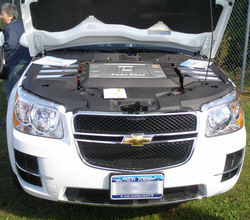 More recently, GM showed a 4th generation
fuel cell car at the 2008 Klingberg Auto Show. Based on the Equinox
platform, it is hydrogen fueled and one a of ~100 car test fleet
operating in NYC, Washington DC, Southern California, and probably GM's
Technology Center near Rochester NY. Cold start is a problem for
hydrogen fuel cells since the water produced tends to stay in the fuel
cell and freeze, and the slower kinetics at low temperatures lowers the
cells output. The GM representative from the NY Technology Center
indicated that 0°F was about the limit for this series of fuel
cells. He also said that the Equinox held about 8 gallons of liquid
hydrogen for a range of about 200 miles.
More recently, GM showed a 4th generation
fuel cell car at the 2008 Klingberg Auto Show. Based on the Equinox
platform, it is hydrogen fueled and one a of ~100 car test fleet
operating in NYC, Washington DC, Southern California, and probably GM's
Technology Center near Rochester NY. Cold start is a problem for
hydrogen fuel cells since the water produced tends to stay in the fuel
cell and freeze, and the slower kinetics at low temperatures lowers the
cells output. The GM representative from the NY Technology Center
indicated that 0°F was about the limit for this series of fuel
cells. He also said that the Equinox held about 8 gallons of liquid
hydrogen for a range of about 200 miles.
An alternative is to generate the hydrogen on-board from methanol in a 'reformer'. Although this was used in the NECAR-3, the reformer produces carbon dioxide as well as hydrogen and adds complexity, weight and expense. However, methanol can be easily stored and dispensed just as gasoline is today.
Even internal-combustion / electric hybrids (such as today's Toyota Prius and the Civic Hybrid, among others) owe something to electrochemical science. Unlike the diesel-electric locomotive [where weight is an advantage and adds to the traction and pulling capacity], low weight is a concern in the automobile. No advantage would be gained if the IC ( Internal Combustion ) engine was sized to provide all the power during peak demand times. Batteries can be used to supplement the IC generated electricity for peak power consumption times (such as drag races from a red light or entering an Interstate.) Regenerative braking can also improve a EV's efficiency by turning the electric motor into a generator during braking. Rather than producing heat and brake-pad dust, the kinetic energy of motion is converted into electrical energy and stored in the battery.
Supercapacitors also play a significant role in the EV. Because they can be efficiently charged rapidly, they make excellent candidates for storing the energy from regenerative braking. They are used in the Honda's FCX V3 fuel cell EV for regenerative braking.
I'm
not the only one who associates the EV with electrochemistry!
See Penn State's "Electrochemical
Engine Center" website.

Treasure Map
A TURING GUIDE
Bob's Bookshelf
ECLECTIC SELECTIONS
Search!
THIS SITE or THE WEB
Awards
ALMOST FAMOUS!


